At a local gathering of friends the other day, the classic puzzle book Maze, by Christopher Manson, came up in conversation. Many, myself included, recalled encountering it not too long after its original 1985 publication date. At the time, we all found it a fascinating artifact, though a completely inscrutable puzzle.
The book is still for sale, as it turns out, and there's also an online, hypertext version of the book you can wander through freely. (I note that the website appears to reside among the archives of an early electronic-publishing venture, and has remained unmodified since the mid-1990s. Sadly, the scanned illustrations are formatted to fit the relatively dinky computer displays of that era, resulting in much of the fine detail getting lost. I suppose I should encourage you to go buy the book, if you find them sufficiently intriguing.)
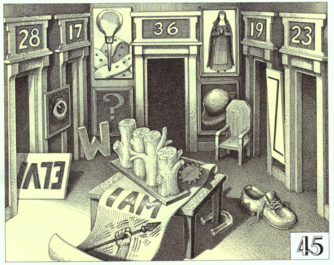 I should correct myself and call the book semi-scrutable, at least. It represents a labyrinth of connected chambers, you see, where each page features a haunting and evocative illustration of one room, trimmed with a short bit of text where the book's mysterious narrator leads a group of squabbling explorers through. The first part of the book's puzzle, then, is simply to find a path that takes you from the entrance to the maze's center and back in 16 steps. The harder part involves teasing the text of a riddle out of all the depicted stuff that lay along this route. And this is where most mortals get stopped, finding themselves with a pile of stuff and no clues.
After I returned home that evening, it occurred to me that I probably hadn't thought much about Maze since the ascent of Wikipedia, and surely it spelled out the solution. Why, yes. And what a solution! It's amusing I can look at this more than 20 years after the book's original publication and tell you why this would get razzed by any of the hardcore puzzle people I know today.
Granted, it was supposed to be very hard, because there was a cash-money prize for the first correct response. But the Wikipedia article implies that they overdid it, since the publishers extended the deadline at least once, and it's unclear if any claim was ever made. And no wonder, really; the solution demands you selectively perform wordplay on picture and text elements along the path, but gives you no clues as to which elements are important, and what should be done with them.
For example (and I'm about to get a little spoilery here) on this page, it happens that you're supposed to get a word by taking two picture elements and anagramming them together. But for all you know, maybe you combine the A with BELL and perform a sound-alike wordplay to get ABLE. Or perhaps the word is simply BELL, after all. Or a dozen other things suggested by the image. They all seem equally right - which is to say, none especially so.
Carry this feeling over the path's 16 pages, and I assert you've got an utterly unsolvable combinatorial explosion. I would be quite interested to learn of integral clues I'm overlooking, though, or to hear about someone who solved the book without any hints! Until then, I must conclude that for all the book's beauty - and it is quite a lovely thing to flip through - as a puzzle, it would get booed off the stage at the MIT mystery hunt.
More important than its puzzle, however, is the book's legacy. Without a doubt, the book left a lasting inspiration to many, stoking a hunger to try solving more baroque and beautiful puzzles, even if that means having to create them first. You can see echoes of Maze in art-heavy digital adventures such as Myst. In fact, the stimulus for this group recollection among friends was a new puzzle designed with Maze in mind, by Gameshelf pal Andrew Plotkin. I have it on good authority that it was cracked by dedicated solvers within a day.

Kit Manson's other puzzle book was _The Practical Alchemist_, and it was an entirely different sort of thing -- a hybrid of a word chain (changing one letter at a time) and what we would today call a hidden-object puzzle game.
The illustrations were equally great.
No prize, though. The answer was in the back. I guess his publisher decided that the gimmick hadn't worked out for _Maze_. I stapled the back page shut, and spent a summer working on it. Wound up discovering a solution, but it was kind of strained, and it wasn't the one the author listed.
You shouldn't be trying to actually solve Maze! Everyone knows that the real puzzle is trying to turn the rooms into a floor plan of an actual house. (Of course, if you ever got around to turning the floor plan into a real building you'd have to decide what's behind the camera in all the pictures.)
So hard to get building permits for the bottomless pit.
For Online Hypertext version with working image map,
go to http://obs-us.com/obs/english/books/holt/
Or
Replace 'german' with 'english' in the address
http://archives.obs-us.com/obs/german/books/holt/books/maze/index.html
There are at least three other MAZE hypertext versions in addition to the original listed above.
they are:
http://home.rochester.rr.com/jbxroads/maze/2frame.html --adapted by John Baily, and;
http://dreadfulandsinister.athanon.com/tour.htm
--and;
http://www.robbio.i12.com/Maze/index.htm --adapted by Bea and Rob
Thanks for the note about image-maps. I'm dumb for not noticing that problem when I linked _Maze_ in my puzzle page.
The rochster.rr.com site appears to just display with original (with broken image maps) with an added sidebar with a room index.
I like the i12.com site -- better, more recent scans. (Where by "more recent" I mean "bigger". The original 1996 version was formatted for tiny bandwidth and tiny screens.) The hotspot display is nice, and cleverly avoids, how shall I put it, giving away too much. :)
The athanon site is a nice layout, but uses the same old (small) gifs as the original.
On March 28, 2008 Stephen said:
There are at least three other MAZE hypertext versions in addition to the original listed above.
they are:
http://home.rochester.rr.com/jbxroads/maze/2frame.html --adapted by John Bailey
That URL is now:
http://home.roadrunner.com/~jbxroads/maze/2frame.html
Thanks for the update.
You didn't mention Christopher Manson's third puzzle book, "The Rails I Tote." Rather than a single puzzle, it's a book of 30-odd puzzles. Each consists of an illustration of a spoonerism, with an accompanying 1-page short story. The challenge is to figure out what the spoonerism is. E.g. if he illustrates keys and parrots, the answer is "peas and carrots." Like The Practical Alchemist, the answers are all in the back of the book, but like Mr. Plotkin, I've kept the answers hidden...and I still work on them occasionally, about 15 years after buying the book!
That, I'm sure, is because I never heard of _The Rails I Tote_. I was buying these books long before the Web, and I never thought of doing a search later on.
I'll look for it. Thanks.
So, does anyone have the solution to the Maze???
I'm sure it's out in the Webworld somewhere. But for the record, I'll type in exactly the slip of paper I received when the contest ended:
----------
MAZE CONTEST SOLUTIONS
1-26-30-42-4-29-17-45-23-8-12-39-4-15-37-20-1
What house will all live in?
Like Atlas, you bear it upon your shoulders.
(The World-Earth-The Globe)
----------
Here is a complete walkthrough of all the rooms in the Maze:
Here is a complete walkthrough of all the rooms in the Maze:
http://www.davegentile.com/stuff/maze.html
I am a long term fan of Christopher Manson's MAZE. I just launched (today) a site dedicated to book where fans can come together and work out solutions to the various puzzles. I also have information about Manson's other works and everything I could find about the genre of puzzles invented by Manson, which I have dubbed the Immersive Visual Puzzle. The address is IntoTheAbyss.net.
I know this is a pretty old post, but it was one of my inspirations for writing Beth--my attempt at making a MAZE-inspired puzzle for Mystery Hunt (and it didn't get booed off the stage--in fact, it's gotten some pretty positive reviews so far). I'm excited to add this to the conversation :)
Oops, sorry for the malformed HTML! Meant to make this link: http://web.mit.edu/puzzle/www/2015/puzzle/beth/
Yes, when it popped up, a cry of delight ran around our Hunt room.
Mind you, that was early in the weekend and we weren't yet tired. :) But it was appreciated.
For the benefit of posterity, I've posted scans of the clue letter and the solution letter that I got after entering the contest. (Needless to say, my solution was incomplete -- I only had the first part.)
http://eblong.com/zarf/mazebook.html
There is now all 45 pages solved of unique solutions at amazed dot blogspot dot com
There is much more than the two answers above,
You will be amazed.